
Health - Sports Medicine
The Doctor Who Invented Ice It And Rest It Quietly Took It Back In 2015 - And Millions Are Still Icing An Elbow That Only Gets Worse
Why the standard advice for chronic elbow pain has been backwards for years - and what the tendon actually needs instead.
 Carter Marsh
There is a quiet reckoning happening in sports medicine, and if you’ve been fighting stubborn elbow pain for months or years, you deserve to hear about it — because it explains, more cleanly than anything your doctor likely told you, why nothing you’ve tried has held.
Let’s start with the fact that reset the whole field.
The man who wrote the rulebook spent his later years unwriting it
In 1978, a physician named Dr. Gabe Mirkin published a bestselling sports-medicine book and coined a four-letter acronym that would go on to shape how the entire world treated injuries for the next four decades: RICE — Rest, Ice, Compression, Elevation.
It became gospel. Every coach, every athletic trainer, every family doctor, every parent with a bag of frozen peas has repeated it. It is almost certainly the reason you reached for an ice pack and decided to “rest it.” And then, decades later, Mirkin did something almost no one in his position ever does. He publicly reversed himself:
“Coaches have used my ‘RICE’ guideline for decades, but now it appears that both Ice and complete Rest may delay healing, instead of helping.”
— Dr. Gabe Mirkin, who coined RICE in 1978
He went further, explaining the physiology of why: applying ice, he wrote, “causes blood vessels near the injury to constrict and shut off the blood flow that brings in the healing cells.” Independent write-ups confirm the reversal plainly — even Mirkin himself has publicly retracted the advice. The correction, though, still hasn’t reached most of the people repeating it.
Why this matters more for your elbow than almost anywhere else
To understand why the RICE reversal hits chronic elbow pain especially hard, you have to understand what that pain actually is — because it’s almost never what the name “tennis elbow” implies.
Most people, and frankly a lot of the advice they’re given, treat it as tendinitis — an inflamed, angry tendon. But the chronic, months-long, keeps-coming-back version is usually something different: tendinosis, a degenerative condition. As one physical therapy group explains, in these cases the painful tendons “do not actually become inflamed, but rather their cellular structure breaks down over time.”
This single distinction quietly demolishes the standard playbook. You cannot “reduce inflammation” in tissue that isn’t primarily inflamed. If the real problem is that the tendon has degenerated, then anti-inflammatory strategies are aimed at the wrong target entirely. So what does degenerated tendon tissue actually need? The answer is the thread that ties this whole story together.
The blood-flow problem at the heart of it all
Tendons are unusual tissue. They are, by nature, poorly supplied with blood. As one recovery source puts it, tendons “have reduced blood supply and poor circulation, so they heal very slowly.” That’s precisely why an elbow can nag for months while a cut on your hand closes in days.
Now overlay Mirkin’s reversal on top of that fact, and the failure of the standard advice becomes almost mathematical. Rest reduces circulation to the area. Ice constricts the blood vessels and, in Mirkin’s words, shuts off blood flow. So for a tissue that is already blood-starved and needs more circulation to rebuild, the two most commonly prescribed interventions do the exact opposite of what it requires.
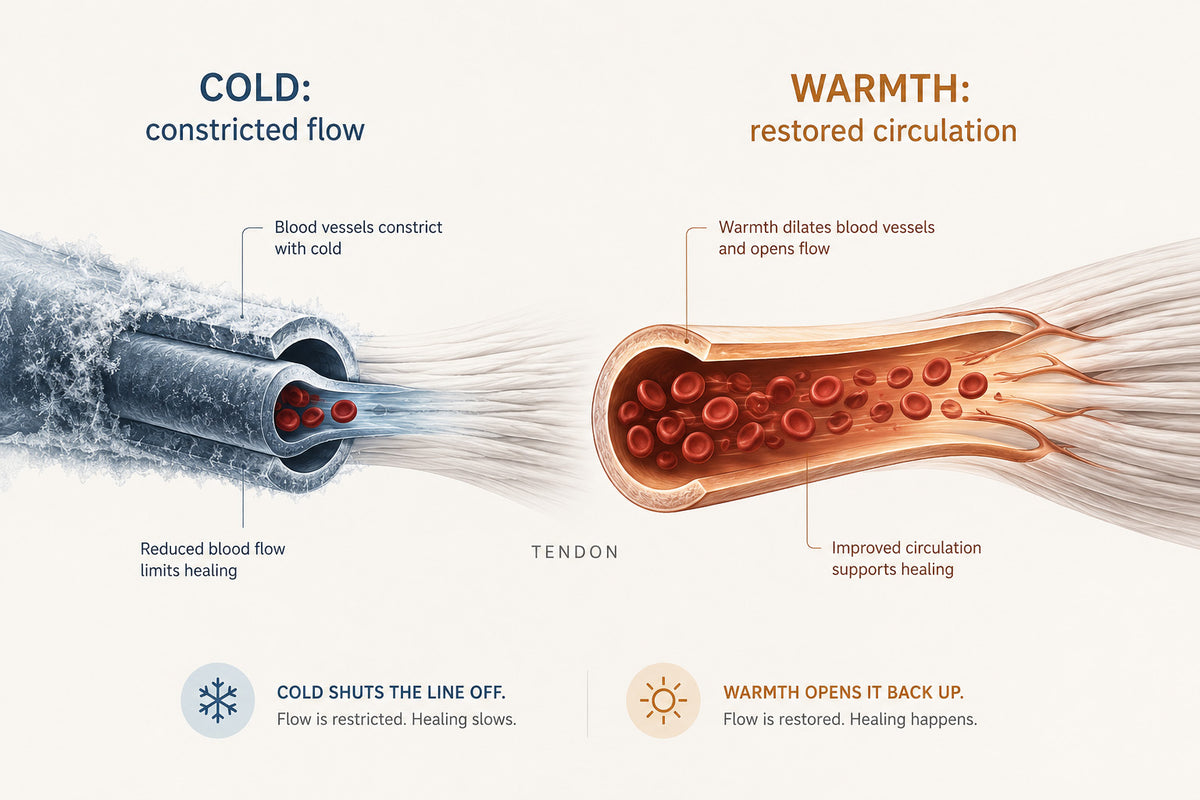
You can rest and ice a frozen pipe indefinitely and it will never thaw itself that way. That, in mechanical terms, is what has been happening in millions of elbows following advice its own author disowned.
What actually addresses the root cause
If the problem is a blood-starved, degenerated tendon, then the logical intervention is the one thing rest and ice cannot provide: increased blood flow. And the simplest, oldest, most accessible way to drive blood flow into a joint is heat.
This isn’t fringe. The Mayo Clinic states it directly: “Heat may be more helpful for ongoing tendon pain, often called tendinopathy or tendinosis. Heat can boost blood flow, and that may help the tendon heal.” Heat dilates the surrounding vessels, opens the circulation, and makes tissue more relaxed and extensible — exactly the state you want before you load a joint with activity.
And here is the detail I find most telling: the sufferers themselves have been intuiting this the entire time. Ask almost anyone with chronic elbow pain when it’s worst, and they’ll say the morning — cold, stiff, locked up. Ask when it’s best, and they’ll describe the feeling after they’ve warmed up. One commenter, describing years of failed icing, wrote simply: “The ice only numbs it to be honest… I’m sitting here right now with the heating pad wrapped around my arm, hoping it will help.” That instinct is correct. Warmth plus circulation is the relief window. Cold plus rest seizes it back shut.
The “issue” nobody connected
Why has this gone wrong for so many people at once? Not a conspiracy — a collision of three ordinary things.
First, a sport exploded. Pickleball and racquet sports pulled enormous numbers of older recreational athletes onto the court, and the injury data followed: one study found that “86% of emergency department visits due to pickleball-related injuries occurred in people over 60 years old.” Second, a “play through it” culture: research on pickleball players found “about one-third of respondents continued to play despite pain” — loading already-degenerating tendons harder, not less. Third, and most importantly, they were all handed a protocol built for acute injury — rest and ice — and applied it to a chronic, degenerative problem where it doesn’t fit. As one clinic put it bluntly, “the days of ‘just rest and ice it’ are definitely over.”
What this means for the deep-heat approach
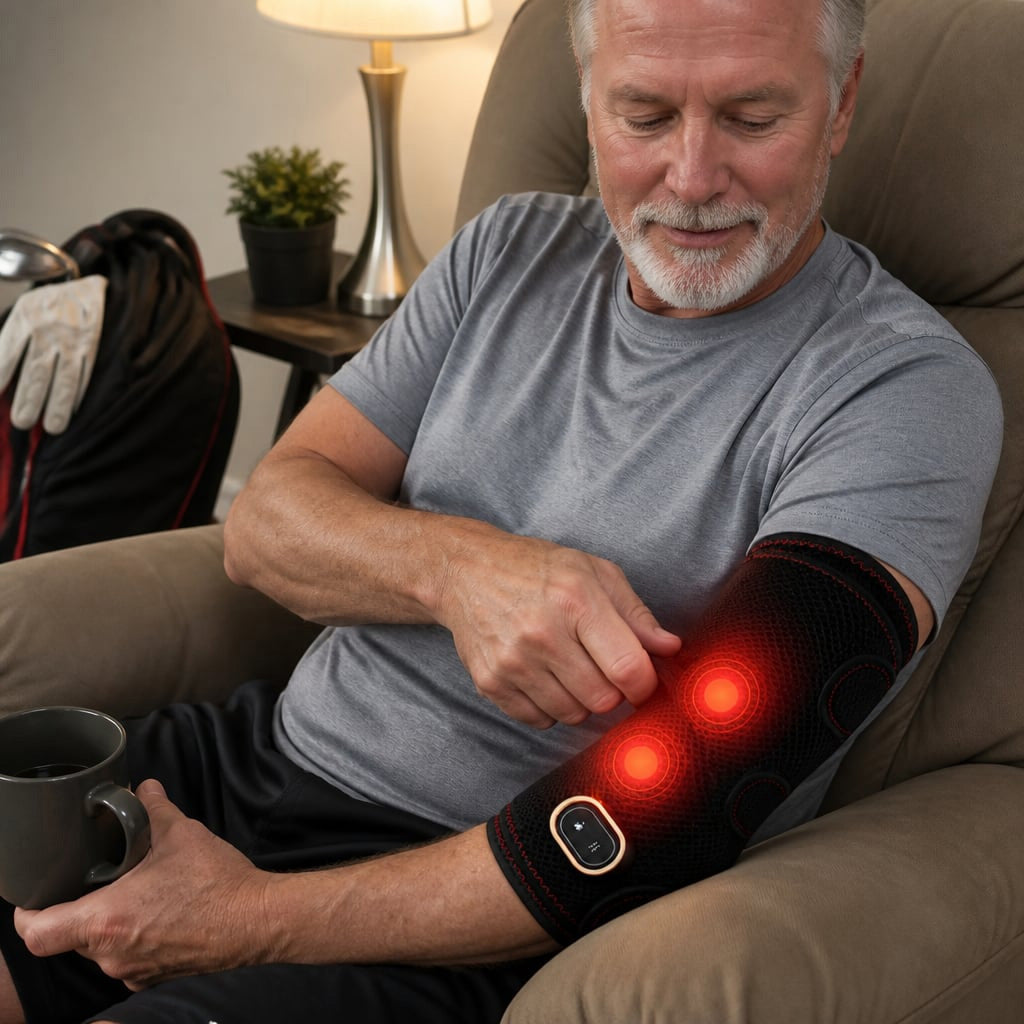
Understanding all of this changes what you reach for. It’s worth knowing that a household heating pad, while sensible in theory, tends to fall short in practice — it warms the skin’s surface and fades within an inch, while the tendon that’s actually hurting sits deeper, wrapped around the joint. The category is right; the surface-level tool often isn’t enough.
That gap is the reasoning behind purpose-built heated braces like the Stowce Heated Elbow Brace. It is not a heating pad and it is explicitly not a medical device — it’s a wrap that uses fast-heating carbon-fiber wire to drive heat deeper into the joint rather than just warming the surface, with an added gentle vibration mode as a second circulation driver. Used before activity, the aim is to warm and prep stiff tissue so it isn’t loaded cold. Used after, it keeps warmth and circulation moving through the recovery window. The honest description of what it does is straightforward: it supports blood flow, warms and preps the tissue, relaxes the muscles, and soothes stiffness.
None of this is a miracle, and anyone promising one should lose your trust immediately. What it is, is coherent — a way to give a blood-starved tendon the circulation that rest and ice, by their own mechanism, cannot.
The tissue was never asking to be frozen. It was asking to be fed.
See the Stowce Heated Elbow BraceADVERTISEMENT. This is an advertorial and paid marketing communication, not a news article, editorial, or independent consumer report. It is not written or endorsed by any physician, publication, or institution named or quoted, and any expert statements are drawn from publicly available sources cited for context only. Testimonials and outcomes reflect individual experiences and are not a guarantee that you will achieve the same or similar results.
This article is for general informational purposes and does not constitute medical advice; consult a qualified professional about your individual situation. The product referenced is intended to support blood flow, warm and prep tissue, relax muscles, and soothe stiffness before and after activity. It is not a medical device and is not intended to diagnose, treat, cure, or prevent any disease. Statements have not been evaluated by the FDA. Individual experiences vary.